
Performance Marketing
Industry: Retail / Food & Beverage

355K+
People reached
In short
Arcetis rebuilt a multi-location restaurant chain's direct-ordering funnel — landing page structure, mobile responsiveness, checkout friction — and then built a full-funnel Meta Ads strategy (brand awareness, engagement, and conversion campaigns) with dedicated campaigns per location. Online sales scaled from a baseline of roughly $600/month across all locations combined to $22,285+ tracked over the campaign period, reaching 355K+ people across 4 scaled locations on approximately $1,600 USD in Meta ad spend.
A multi-location restaurant chain came into this engagement generating almost no revenue through its own website — despite running several physical locations, its combined direct online sales sat at roughly $600 per month. The business had no dedicated paid advertising program, relied on foot traffic and word of mouth rather than a repeatable digital acquisition channel, and its website ordering experience wasn't converting the traffic it already had. For a multi-location food & beverage business, direct online ordering represents margin that doesn't get shared with third-party delivery marketplaces, so the objective was straightforward: fix the ordering experience first, then build a paid media engine on Meta platforms capable of driving incremental, trackable online sales at each location individually rather than as one undifferentiated brand campaign.
Before this engagement, the restaurant chain's website functioned more as a directory listing than a sales channel. Combined across every location, it was generating approximately $600 per month in direct online sales — a figure that made it clear the site wasn't being used as the primary path to a purchase, even by customers who found the business online. Three separate but related problems fed into that number. First, low online visibility: with no structured paid advertising strategy in place, the chain's digital presence depended on organic discovery and existing customer habit rather than any deliberate acquisition effort. Multi-location restaurant brands compete for attention against national chains and third-party delivery marketplaces that spend heavily on their own paid channels, so a location with no paid presence of its own is effectively invisible to anyone not already looking for it by name. Second, an underperforming ordering experience. Even the traffic that did reach the site wasn't converting well, which pointed to friction somewhere between landing and checkout — page structure that didn't clearly route a visitor toward ordering, a mobile experience that likely wasn't holding up (restaurant ordering traffic skews heavily mobile), and checkout steps that likely introduced enough friction to cause abandonment. Any paid media spent driving traffic into that funnel would have been wasted until this was addressed. Third, no structured paid advertising strategy meant there was no consistent measurement layer either — no reliable way to see which location, which offer, or which audience was actually producing sales, and no infrastructure such as pixel tracking or conversion events to optimize campaigns against real purchase data rather than guesswork. Together, these three problems compounded: a chain with multiple physical locations, each with its own local customer base and competitive set, was leaving that local relevance unused online, funneling whatever demand did exist into a checkout flow that likely lost a meaningful share of it, and had no advertising engine or tracking in place to identify or fix any of it. The fix needed to work on a modest budget and needed to prove itself in dollars tracked, not impressions served.
Arcetis led the engagement end to end, working directly with the restaurant chain on both the technical and paid media sides of the problem. Arcetis audited the existing direct-ordering funnel and rebuilt the landing page structure, mobile responsiveness, and checkout flow to remove friction between a visitor arriving and completing an order. Arcetis designed and implemented Meta Pixel tracking and conversion event infrastructure so every campaign could be measured against actual online sales rather than clicks or impressions. Arcetis built and managed a full-funnel Meta Ads strategy — separate brand awareness, engagement, and conversion campaigns — and structured dedicated campaigns per location rather than one blended brand campaign, so each location's performance, budget, and creative could be optimized independently. Arcetis owned campaign strategy, creative direction, targeting, budget allocation, and ongoing optimization for the duration of the tracked campaign period.
Before any ad spend went out, Arcetis rebuilt the structure of the chain's direct-ordering pages. That meant reworking page hierarchy so a visitor is routed toward ordering rather than browsing, tightening the path between landing and menu/cart, and removing the layout and content issues that were letting existing traffic bounce without converting. This step came first deliberately — sending paid traffic into a broken funnel wastes spend and produces misleading campaign data, so fixing conversion capacity had to precede any Meta Ads investment.
Restaurant ordering traffic is overwhelmingly mobile, so Arcetis addressed responsiveness issues that were likely costing conversions on phones specifically — layout breakpoints, tap targets, and page behavior on mobile connections. Arcetis also reviewed and simplified the checkout sequence itself, reducing the number of steps and points of friction between adding an order and completing payment, since checkout drop-off is one of the most common places a marginal ordering experience loses sales it already earned.
Arcetis installed Meta Pixel across the ordering funnel and configured conversion events tied to actual online sales, giving the campaigns a measurement layer that didn't previously exist. This was the infrastructure that made every other number in this engagement — reach, spend, and tracked sales — verifiable and attributable, and it's what allowed Meta's ad delivery system to optimize toward real purchases rather than generic engagement or link clicks.
Arcetis built a three-stage Meta Ads program covering brand awareness, engagement, and conversion — rather than running conversion campaigns in isolation against a cold audience. Awareness campaigns built reach and familiarity with the chain's locations, engagement campaigns warmed that audience, and conversion campaigns, backed by pixel data, were dedicated to driving tracked online orders. Structuring the funnel this way is standard practice for a business with limited existing brand recognition online and a modest budget to deploy efficiently.
Rather than one blended campaign representing the whole chain, Arcetis built dedicated Meta Ads campaigns for each location. That let targeting, budget, and creative be tuned to the specific geography and customer base around each restaurant, and let performance be evaluated location by location instead of being averaged into a single number that could hide underperforming locations. Four locations were scaled through this structure over the campaign period.
Arcetis managed the campaigns on an ongoing basis for the duration of the engagement — monitoring spend, reach, and conversion data, and reallocating budget toward the audiences, locations, and creative that were converting. With Meta ad spend held to roughly $1,600 USD total, disciplined ongoing optimization was necessary to convert that budget into the $22,285+ in tracked sales rather than spreading it thinly across underperforming placements.
Cropped directly from the actual account — business-identifying details removed.
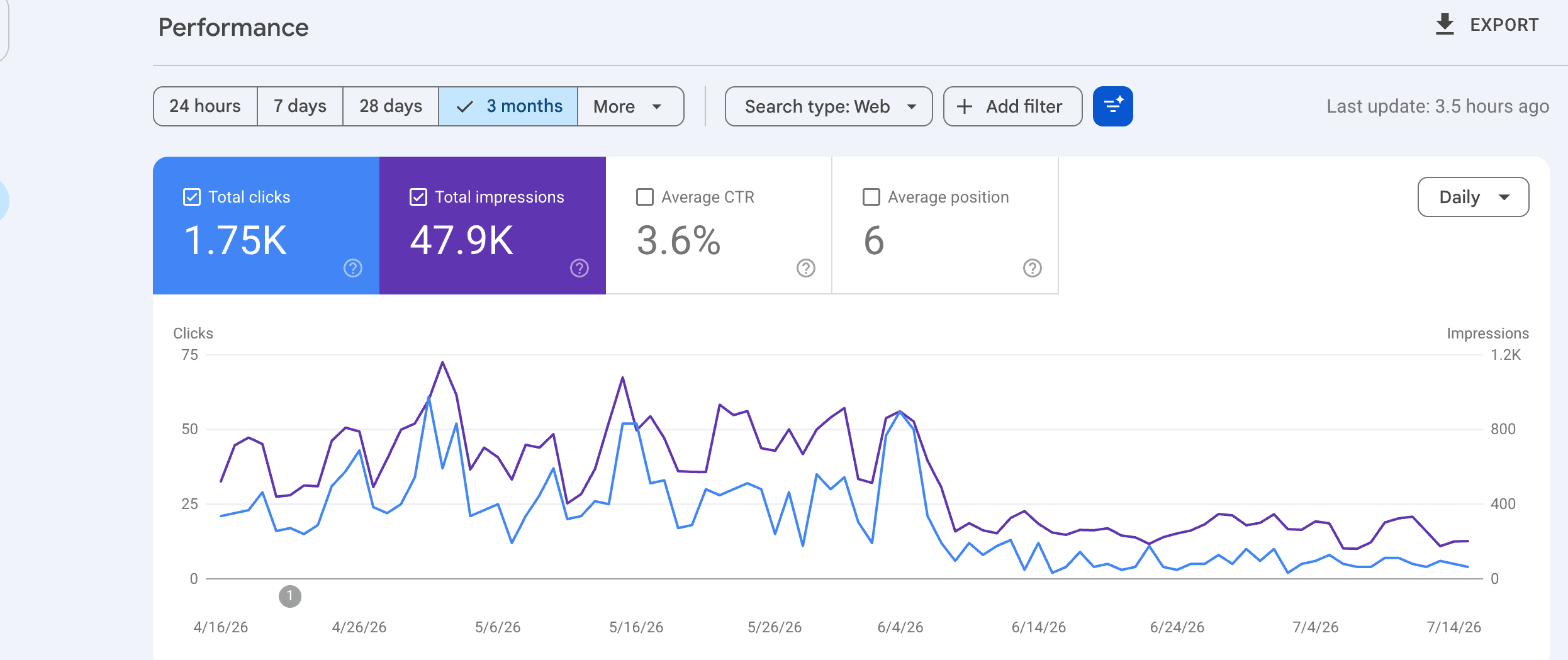
Real Google Search Console performance data from this engagement — clicks, impressions, CTR, and average position (business name and domain redacted).
The work followed a sequence that's standard for any performance marketing engagement built around a low-converting funnel: fix conversion capacity before buying traffic, instrument measurement before optimizing, then build the media plan on real data rather than assumptions. The first phase focused entirely on the direct-ordering funnel itself, with no ad spend involved. Arcetis reviewed the existing landing pages against how a customer actually moves from arrival to completed order — what they see first, how many steps separate a link click from adding to cart, where the "order now" path competes with distracting alternative navigation. Restructuring the page hierarchy meant collapsing that path and making the ordering call-to-action the clear priority on every page a paid campaign could plausibly land traffic on. Mobile responsiveness was treated as a first-class requirement rather than an afterthought, given that Meta Ads traffic to a restaurant's site skews heavily toward mobile devices — layout, load behavior, and tap-target sizing on phones were reviewed and corrected. Checkout friction reduction followed the standard discipline of minimizing the number of fields, clicks, and decision points between starting an order and confirming payment, since every additional step is a well-documented drop-off point in direct-ordering conversion flows. With the funnel in a state that could actually convert traffic, Arcetis moved to instrumentation: installing Meta Pixel on the site and wiring conversion events to fire on actual completed online orders, not just page views or add-to-cart actions. This is the layer that let Meta's delivery algorithm optimize toward the outcome that mattered — a completed sale — and gave Arcetis a live, per-location view of what spend was producing. The media strategy itself was built as a funnel, not a single campaign type. Brand awareness campaigns ran first to build reach and familiarity for each location among people in its local area — standard practice for a multi-location retail/food & beverage brand where a meaningful share of the local audience may not yet be aware of, or actively considering, the business online. Engagement campaigns followed, designed to warm that awareness audience and generate the kind of interaction Meta's algorithm treats as a signal of intent. Conversion campaigns sat at the bottom of that structure, targeted at audiences already exposed to the awareness and engagement stages plus pixel-informed retargeting pools, and were the campaigns held directly accountable for tracked online sales. Structuring campaigns per location rather than as one chain-wide campaign followed from a simple operational reality: each restaurant location has its own local radius, competitive set, and customer base, and blending them into a single campaign would have made it impossible to tell which locations were actually responding to the spend. Running four locations as scaled, independently managed campaigns meant budget could be shifted toward what was converting and away from what wasn't, throughout the campaign period, on a total Meta ad spend of roughly $1,600 USD.
Before any paid traffic was purchased, the direct-ordering funnel was restructured for conversion: page hierarchy simplified around the ordering path, mobile responsiveness corrected for a traffic mix that skews mobile-first, and checkout friction stripped down to the fewest necessary steps. Sequencing the work this way is a deliberate technical decision — running Meta Ads against an unfixed, low-converting funnel produces misleading campaign data and wastes spend, since poor performance could be blamed on targeting or creative when the real bottleneck sits downstream at checkout.
Meta Pixel was installed across the ordering flow with conversion events tied to completed online orders rather than surface-level actions like page views. That gave Meta's ad delivery system a real purchase signal to optimize toward, and gave Arcetis attributable, location-level data on what spend was actually producing in sales — the foundation that made the $22,285+ tracked-sales figure measurable and defensible rather than an estimate.
Rather than a single conversion campaign type, the media plan was built in three stages — brand awareness, engagement, and conversion — each feeding audience and signal into the next. Awareness campaigns built reach (355K+ people reached over the campaign period); engagement campaigns warmed that audience; conversion campaigns, informed by pixel data, were the ones held accountable for tracked online sales. This layered structure is standard for a brand without significant existing paid-media history on the platform.
Each of the four scaled locations ran as its own dedicated Meta Ads campaign rather than being folded into one blended, chain-wide campaign. That let targeting radius, budget, and creative be set per location and let performance be read location by location — a structural choice that matters for any multi-location retail or food & beverage brand where local demand, competition, and customer behavior differ meaningfully from one location to the next.
The entire program ran on approximately $1,600 USD in total Meta ad spend, which meant ongoing optimization mattered more than it would on a larger budget — reallocating spend toward the locations, audiences, and creative producing tracked sales, and away from underperformers, throughout the campaign period. The $22,285+ in tracked online sales that resulted reflects disciplined, small-budget execution rather than scale of spend.
The funnel the ad campaigns pointed to runs on Next.js (App Router) with React and Tailwind CSS, not a page-builder template — chosen specifically so the ordering path, mobile layout, and load behavior described above could be controlled precisely rather than worked around. An interactive, swipe-based flip-book menu gives customers a tactile way to browse the full menu on mobile before ordering, and each location deep-links out to its own storefront on a third-party ordering platform rather than forcing a single blended checkout flow across all locations. A hand-rolled IP-based rate limiter protects the contact and catering request routes without depending on a third-party service, and confirmation emails are sent through a React Email + Resend pipeline directly from the app's own server routes.
People reached
Online sales tracked
Technology used
Key learnings
This engagement is a useful illustration of a sequencing principle that's easy to skip under pressure to "just run ads": fixing the funnel has to come before buying traffic into it. A chain generating roughly $600/month in direct online sales didn't have a media problem as its first problem — it had a conversion-capacity problem, and no amount of Meta Ads spend would have fixed that on its own. Addressing landing page structure, mobile responsiveness, and checkout friction first meant that when paid media did start running, the traffic it drove had somewhere productive to go. It also demonstrates that a full-funnel paid media structure — awareness, engagement, and conversion campaigns run together rather than jumping straight to conversion ads against a cold audience — can work on a modest budget when it's paired with real measurement. Roughly $1,600 USD in total Meta ad spend produced $22,285+ in tracked online sales, a result that depended on Meta Pixel and conversion tracking being in place from early on, not on spend volume. Finally, running the four scaled locations as separate, dedicated campaigns rather than one blended brand campaign meant performance could actually be read and acted on location by location — a structural decision that matters for any multi-location retail or food & beverage business considering paid social as a channel.
Because paid traffic sent into a low-converting funnel produces misleading results and wastes budget. In this engagement, the client's website was generating only about $600/month in direct sales before any ad spend, which pointed to a conversion problem — page structure, mobile responsiveness, and checkout friction — that had to be addressed first. Only once the ordering experience could actually convert traffic did Meta Ads campaigns begin.
By building dedicated campaigns per location rather than one blended, chain-wide campaign. That allows targeting radius, budget, and creative to be tuned to each location's local customer base and lets performance be tracked and optimized location by location. In this engagement, four locations were scaled this way.
It means running distinct campaign types for different stages of the customer journey — brand awareness campaigns to build reach and familiarity, engagement campaigns to warm that audience, and conversion campaigns, backed by Meta Pixel data, aimed specifically at driving tracked purchases. Rather than running conversion ads alone against a cold audience, each stage feeds signal and audience into the next.
Through Meta Pixel and conversion event tracking installed on the site's ordering flow, tied to completed online orders rather than clicks or page views. That's what made the $22,285+ in tracked online sales in this engagement an attributable, measured figure rather than an estimate, and it's what let campaign budget be optimized toward what was actually converting.